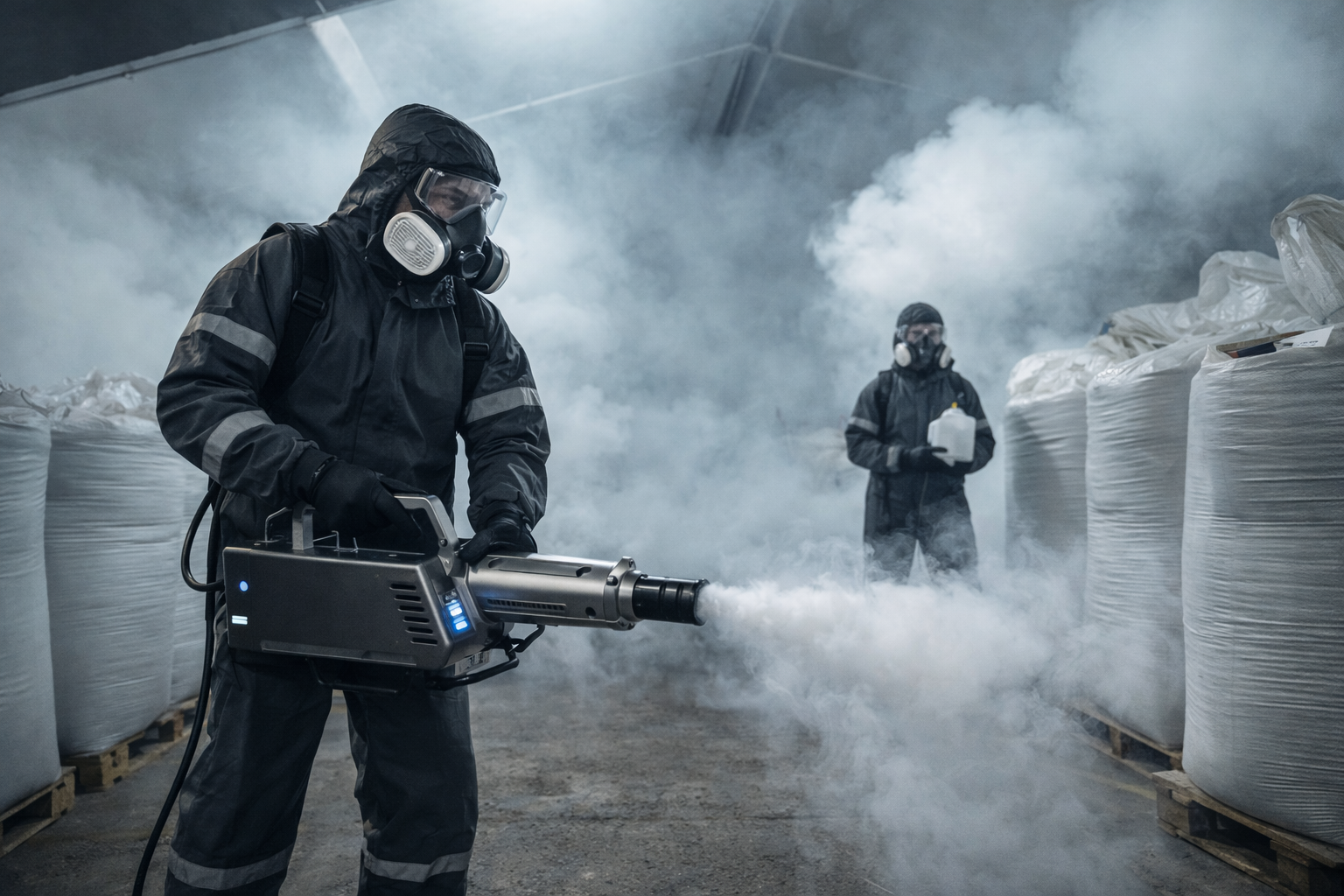
Detailed service explanation
How grain gassing and fumigation protects storage quality
Grain protection requires both biological control and process discipline. Pests in stored
commodities can spread inside bulk mass quickly, especially when temperature, moisture, and
airflow create favorable micro-conditions. Surface-only actions often fail because activity
can continue in deeper layers. Fumigation addresses this by using a controlled gas phase
that reaches difficult internal zones when managed correctly.
Before treatment starts, storage systems are mapped to identify exposure boundaries,
leakage points, and critical transit segments. This includes silo tops, loading bays,
conveyor transfer points, and adjacent technical voids. A proper setup defines how
concentration, time, and containment interact. If one variable is unstable, treatment
performance can drop significantly. For this reason, preparation quality is as important as
the active phase itself.
During application, strict safety control is mandatory. Personnel access, warning zones,
and timing windows must be planned in advance. The objective is effective pest reduction
while maintaining worker safety and operational continuity. After exposure, ventilation and
clearance steps are performed before re-entry. Verification confirms that the treated zone
is stable and ready for normal use.
Long-term prevention depends on storage hygiene discipline: regular cleaning schedules,
moisture management, and transfer-point checks. Fumigation is highly effective when used as
part of a broader monitoring plan, not as an isolated emergency action. This approach helps
preserve grain quality, reduce repeated losses, and support stable production planning.